
The Control Illusion: Why Modern Smart Buildings Are Still Missing a Voice

In the world of corporate real estate and facility management, a long-standing dogma dictates that more data equals more control.
Driven by this premise, organizations have made massive, necessary investments in physical infrastructure. Today, modern office complexes are equipped with exceptional hardware: environmental sensors, smart cameras, intelligent energy meters, and digital access gates. Every single day, this state-of-the-art infrastructure generates gigabytes of valuable logs, metrics, and real-time graphs.
Yet, despite this rich abundance of information, if you ask facility managers or IT directors three basic questions:
Who is truly present in the building right now, and what is their role?
Why are congestion patterns evolving in specific zones?
Is the space dynamically responding to the real-time needs of its occupants?
The answer is often a difficult silence.
The paradox of the modern smart building is not a lack of data. The data is there, and it is highly accurate. The challenge is that these advanced systems often operate in isolated silos. They record individual events, but they struggle to connect the dots. They stream data, but without a unified orchestration layer, that data remains silent.
True intelligence doesn’t lie in the sheer volume of signals we collect. It lies in our ability to turn those signals into coordinated, real-time action.
From Siloed Data to Contextual Intelligence
To unlock the true ROI of premium hardware deployments, an building must move beyond static schedules and isolated alerts. It needs to understand context.
Consider a standard after-hours scenario. At 7:30 PM, an access badge is swiped at a restricted zone gate. The access control system registers a green light: Access Granted. It executed its task perfectly.
However, the access system alone cannot see if an unauthorized visitor closely followed that employee through the door (tailgating). At the same moment, the HVAC and lighting systems might still be running at 100% across the entire floor simply because a pre-set calendar schedule dictates it. The systems don’t know that the floor is empty, except for a maintenance team moving from room to room.
The hardware did its job. The data was captured. But the building missed the reality of the situation because the individual signals were never correlated.
When premium sensors, smart cameras, and access logs stop operating in silos and begin talking to each other, the building gains a brain. It transitions from a reactive structure to a cognitive space.
The Cognitive Trilogy: Eye, Mind, and Nerve
This cognitive evolution is precisely why VAPP developed its integrated ecosystem. We do not replace your existing hardware infrastructure; we orchestrate it, acting as the intelligence layer that connects three distinct capabilities:
- The Eye (Vision+): Advanced computer vision that goes beyond passive recording to interpret identity and behavior in real time, recognizing the difference between a routine employee, a maintenance team, or an unauthorized visitor.
- The Mind (AID4): Predictive analytics that analyze historical occupancy patterns and environmental trends. By factoring in external variables like weather forecasts and corporate calendars, AID4 learns to predict energy and space demand before it happens.
- The Nerve (IoT Builder): The central orchestration platform. It ingests the real-time insights from Vision+ and AID4, correlates them with your existing building systems, and instantly triggers automated responses.
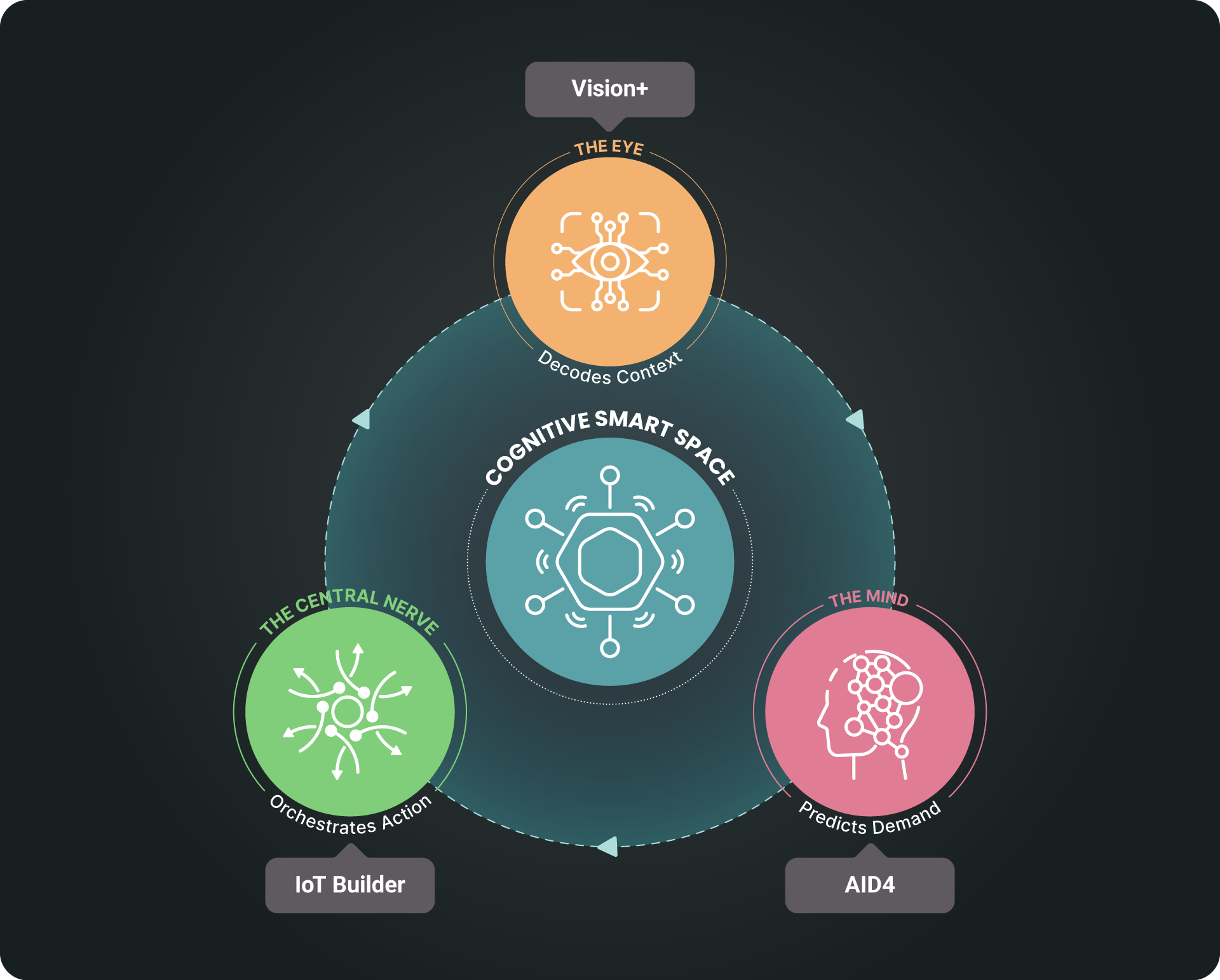
Role Defines Presence
When these platforms work in harmony with your building’s infrastructure, static timers become obsolete. The role defines the presence, and the presence modulates the space.
- Operational Efficiency: If Vision+ detects a cleaning crew after hours, IoT Builder dynamically activates HVAC and lighting only in the specific zones they are currently working in, following them as they move.
- Space Optimization: When a team enters a meeting room, the building recognizes the collaborative activity: it sets the ideal lighting scene, adjusts the climate to comfort mode, and prepares the displays for wireless presentation.
- Intelligent Security: If a visitor enters a restricted area, IoT Builder instantly recognizes the policy violation. It can automatically lock exit gates, activate camera tracking, and dispatch a rich-media alert to the security team—stopping a threat the moment it occurs.
Giving Buildings a Voice
The ultimate goal of a cognitive smart building is to eliminate complexity for the end user. Instead of forcing facility managers to log into multiple dense dashboards, the building becomes conversational.
Authorized users can interact with the space using natural language. Asking “Where is John Doe?” prompts the orchestration engine to instantly cross-reference access events, vision analytics, and calendar data to reply: “John Doe is in Meeting Room 4. The session ends in 12 minutes. Would you like me to notify him?”
By transforming your existing hardware data into a unified dialogue, buildings stop wasting energy, spaces become adaptive, and security becomes proactive. It is time to stop just monitoring our buildings. It is time to start understanding them.